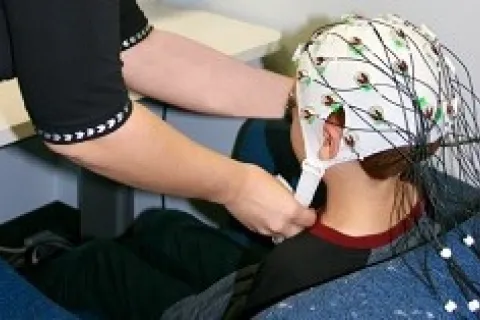
Cheryl Y. Trepagnier, Ph.D. (Linguistics, University of Toronto, 1974), and parent of an adult with autism, proposed the hypothesis that failure to establish basic social interaction skills in early life could itself account for the social and communicative deficits of autism (1995; 1996; 1998). In 1998, she undertook a study to examine autistic face-gaze using video eye-tracking and a virtual reality display. This work has led to publications documenting differences in ASD gaze behavior in response to social stimuli (Trepagnier, 1999; Trepagnier et al., 2000; 2002; Ramloll et al., 2004), and to further research proposals to develop and pilot interventions to modify the course of ASD social development.
With the CUA Autism Research Group, Dr. Trepagnier is developing the Virtual Buddy system, under grant from NIMH, and a bridge grant from Autism Speaks. Virtual Buddy is a video and eye-tracking-based system designed to teach children to attend to and interpret social cues including direction of gaze. The experimental set-up for this project, developed in collaboration with Cori Lathan of AnthroTronix, consists of a "helicopter kiddie ride", furnished with a child's safety car seat, a flat panel monitor and a hidden eye tracking camera. The child's automatically-monitored direction of gaze results in contingent changes in the display, including rewards of preferred video. The goal is to instill in the child the expectation that attending to someone else's locus of interest will be rewarding (Trepagnier et al., 2005; 2006).Cheryl has also worked on social CosmoBot with Anthrotronix, which is a particularly attractive complement to the Virtual Buddy since it affords more active behavior on the child's part and can provide the child with opportunities to control not only its movement but also its social behavior. Both techniques are conceptualized as potential components of a repertoire of technology-aided methods to jump-start and reinforce real-world social interaction.
Dr. Trepagnier is also involved in a project addressing social skills of adults with ASD, in collaboration with SIMmersion, LLC, a company that develops training simulations (e.g., customs inspectors, counselors). This group has received Phase I funding to produce a simulation to teach and provide practice in social conversational skills to high-functioning adolescents and adults with autism.
Selected publications: C.Y. Trepagnier, M. M. Sebrechts, A. Finkelmeyer, M. Coleman, W. Stewart, Jr., M. Werner-Adler (2005). Virtual Environments to Address Autistic Social Deficits. Annual Review of CyberTherapy and Telemedicine: A Decade of VR, 3, 101-108.
Ramloll, R., Trepagnier, C. Y., Sebrechts, M. M., & Finkelmeyer, A. (2004), A Gaze Contingent Environment for Fostering Social Attention in Autistic Children. Proceedings of ACM ETRA 2004(San Antonio, Texas), 22-24.
Trepagnier, Cheryl; Sebrechts, Marc M; Peterson, Rebecca. Atypical face gaze in autism. [References]. [Peer Reviewed Journal] CyberPsychology & Behavior. Vol 5(3) Jun 2002, 213-217. Mary Ann Liebert Publishers, US.
Trepagnier C, (1999). Families with autism. Infants and Young Children;12 (2): 37-47 OCT 1999.
Trepagnier C, Gupta V, Sebrechts MM, & Knott B. (1999). Use of Virtual Reality Technology to Investigate Face Processing by Persons with Autism. In C. Buehler & H. Knops (Eds.) Assistive Technology on the Threshold of the New Millennium; IOS Press: Amsterdam, pp. 709-712.